

FIELD MARSHAL RADOMIR PUTNIK

Field Marshal Radomir Putnik, a distinguished soldier and commander of the Serbian army for forty years, was born in Kragujevac on January 12, 1847. He began his schooling at the age of six and was known for being a diligent, measured, and polite student. However, he had a strong desire to assert himself as a leader and to be heard, a trait that followed him throughout his life. Putnik received his military education at the Artillery School in Belgrade and furthered his training in Russia.
He fought in the Serbian-Turkish Wars (1876-1878) and the Serbian-Bulgarian War of 1885, where he served as Chief of Staff of the Standing Army. In the early 1890s, he was appointed Assistant Chief of the Main General Staff and, in 1893, took command of the Šumadija Divisional Area. However, in 1895, he was removed from his position due to suspicions of collaborating with the Radical Party and retired in 1896.
Following the May Coup of 1903, Putnik was reinstated as Chief of the Main General Staff. He played a pivotal role in shaping the modern Serbian army, introducing tactical problem-solving in the education and training of officers and writing several key military works, including Service of the General Staff I and II, Service in Peace Time, and Service in War Time. He modernized the Serbian army, ensured talented officers held key positions, and kept politics out of the military ranks. Together with Živojin Mišić, he prepared the war plans for the Balkan Wars and the First World War.
From 1912 to 1916, Putnik was the head of the Supreme Command. After the Serbian victory at the Battle of Kumanovo, he became the first Serbian Field Marshal. At the start of World War I, while undergoing treatment at a spa in Gleichenberg, Putnik was called to Belgrade but was briefly imprisoned in Budapest by the Austro-Hungarians. He was soon released, as one Austro-Hungarian general famously remarked, “It is much better for the Serbs to be commanded by an old, uneducated traveler than by one of their younger, French-educated generals”. However, the Serbian army’s victories at the battles of Cer and Kolubara soon proved how wrong the general was.
During the Serbian army’s retreat across Albania towards Greece, Putnik, though old and frail, accompanied his troops. His final order as Chief of Staff was to withdraw the army through Montenegro and northern Albania to the Adriatic Sea. By then, Putnik was gravely ill, and soldiers carried him on a specially made stretcher over the Albanian mountains to Shkodër. In January 1916, he was transported to Corfu and later moved to France for treatment.
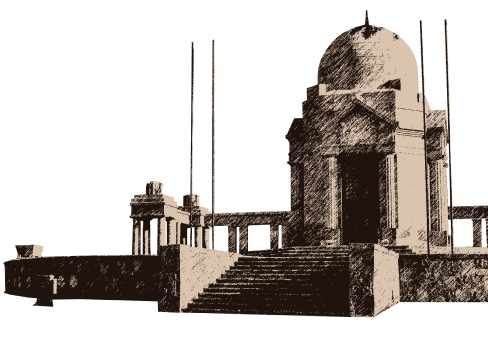
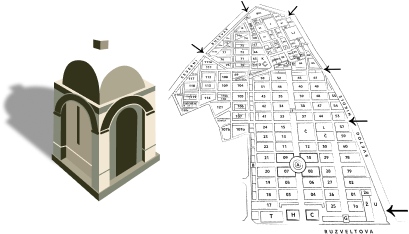
Radomir Putnik passed away in Nice in 1917 and was buried in the Russian Church there. Nearly a decade later, in 1926, his remains were transferred to the New Cemetery in Belgrade. A chapel dedicated to him, designed by architect Aleksandar Vasić, was built in 1929. Located on the central path above the St. Nikola’s Church, the chapel was constructed in the late Serbian-Byzantine style with elements of Art Deco. Made of white marble, it is adorned with figures of Serbian soldiers standing in eternal guard, paying homage to the Field Marshal. Bronze arches featuring relief crosses and swords complete the memorial, with the inscription above the entrance reading, “Thankful Fatherland to Field Marshal Radomir Putnik”.
Section F